Perspective
The New Growth Engine: AI Search, First-Party Data & Performance Marketing
Ad Growth Partner · · 6 min read
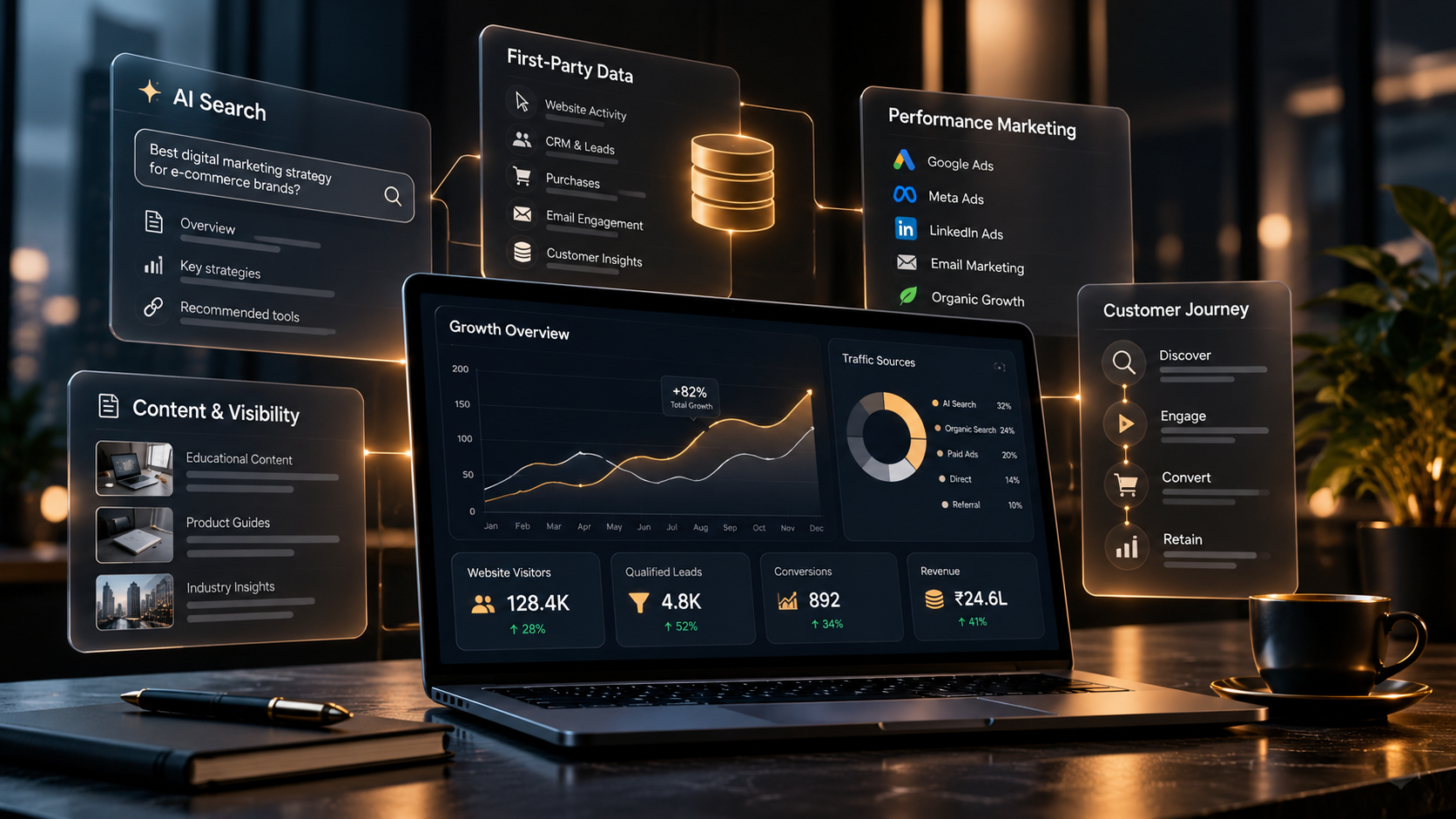
Search is changing from blue links to AI-generated answers. For ambitious brands, the next growth advantage will come from combining AI visibility, first-party data, and performance marketing into one measurable growth system.
The New Growth Engine: AI Search, First-Party Data & Performance Marketing
The way customers discover brands is changing.
For years, digital growth followed a familiar path: someone searched on Google, clicked a result, visited a website, and eventually converted.
That journey is becoming less linear.
Customers are increasingly asking AI systems questions directly and using the answers to discover, compare, and evaluate brands. At the same time, marketers are operating in an environment where third-party tracking is becoming less dependable and first-party customer data is becoming increasingly important.
The result is a new growth equation:
AI visibility + first-party data + performance marketing.
## 1. Search Is Becoming an Answer Engine
Traditional SEO focused heavily on ranking pages for keywords.
AI search changes the question.
Instead of simply asking:
"Who ranks for this keyword?"
Brands increasingly need to ask:
"Will an AI system mention my brand when someone asks a relevant question?"
AI search is becoming a conversational discovery channel. Users can ask complex questions, compare alternatives, and receive synthesized answers without visiting multiple websites.
That means brands need content that is genuinely useful, structured around real customer questions, and strong enough to become a source that answer engines can understand and reference.
SEO still matters. But increasingly, brands need to think about both search engine optimization and answer engine optimization.
## 2. First-Party Data Is Becoming a Growth Asset
As the digital advertising ecosystem evolves, brands need stronger relationships with their own audiences.
First-party data includes information collected directly through a company's own channels — such as website interactions, lead forms, CRM records, purchases, email engagement, and customer feedback.
The value isn't simply having more data.
The value comes from connecting that data to business decisions.
A clean first-party data foundation can help teams understand:
• Which audiences are most valuable • Which campaigns generate qualified leads • Which customers are likely to return • Which content drives meaningful engagement • Where prospects drop out of the funnel
It also gives AI better signals to work with.
AI-powered personalization, lead scoring, segmentation, and marketing automation are only as useful as the data behind them.
## 3. Performance Marketing Needs Better Signals
Performance marketing has traditionally been measured through metrics such as clicks, conversions, cost per lead, and return on ad spend.
Those metrics still matter.
But growth teams increasingly need to connect marketing activity with actual business outcomes.
A lead is not necessarily valuable simply because it is cheap.
A better question is:
"Does this campaign consistently create customers and revenue?"
That requires connecting advertising platforms with CRM and first-party business data.
Instead of optimizing only for volume, brands can begin optimizing toward qualified pipeline, customer value, and revenue.
## 4. AI Doesn't Replace Strategy
AI can generate content, analyze campaigns, identify patterns, automate repetitive work, and accelerate experimentation.
But AI does not remove the need for strategy.
The strongest systems combine human judgment with machine-scale execution.
A growth team might use AI to:
• Analyze thousands of customer interactions • Identify high-value audience segments • Generate and test creative variations • Discover content opportunities • Personalize customer journeys • Identify anomalies in campaign performance • Accelerate reporting and decision-making
The strategic advantage comes from building a system where these capabilities continuously learn from real business data.
## 5. Build One Connected Growth System
The biggest opportunity is not treating SEO, paid advertising, content, CRM, and AI as separate activities.
They should work together.
A customer might discover a brand through an AI-generated answer, visit an article, interact with a paid campaign later, submit a lead form, receive an email, and eventually become a customer.
If each channel is measured independently, much of that journey becomes invisible.
A connected growth system brings those signals together.
The goal is simple:
Discover → Engage → Convert → Learn → Optimize.
Every interaction creates information that can improve the next decision.
## What Should Brands Do Now?
Start with the fundamentals.
Build content around the questions your customers actually ask.
Strengthen your first-party data infrastructure.
Connect marketing platforms with CRM and revenue data.
Measure qualified outcomes rather than vanity metrics.
Use AI to accelerate experimentation and analysis.
And continuously test what creates measurable business impact.
The future of growth won't belong to brands that simply produce more content or spend more on advertising.
It will belong to brands that build better systems for understanding customers, creating demand, and turning that understanding into measurable growth.